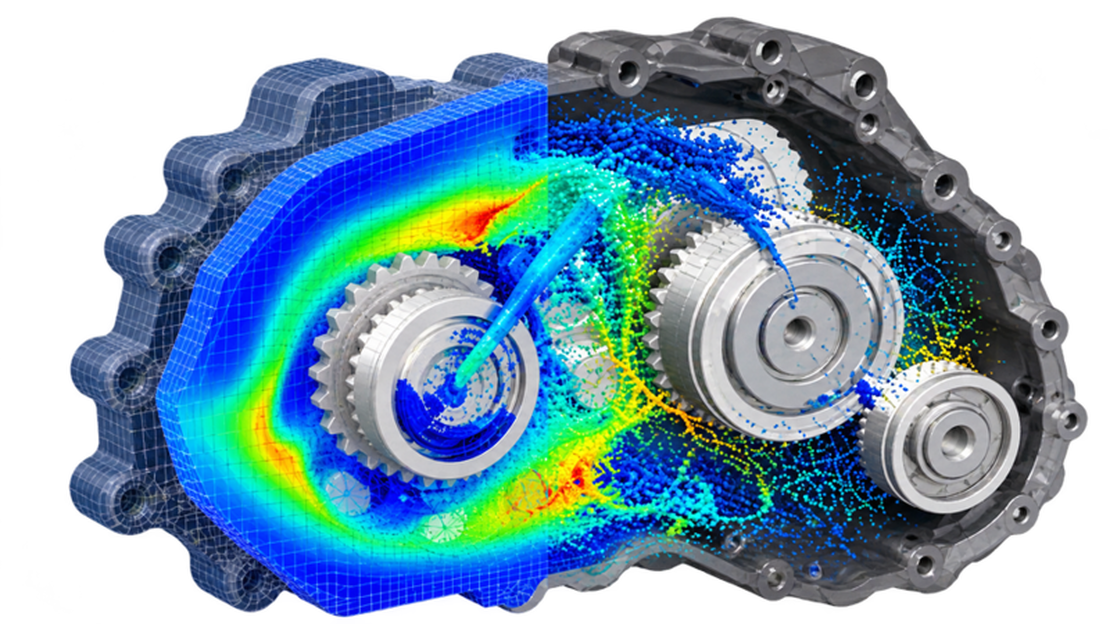
Meshless CFD methods have been used in research for decades, but they remain unfamiliar to many practising engineers who trained on mesh-based tools. The question worth asking is not whether the meshless approach is better in general, but whether it fits the specific problem in front of you.
Intro
This article explains what the meshless method actually is, why it handles certain classes of fluid problems more naturally than mesh-based CFD, and how to assess whether your engineering problem is one of them. For a deeper treatment of the numerical differences between particle-based and finite volume methods, see our blog post Two Paths to Simulating Reality.
What the Meshless Method Actually Is
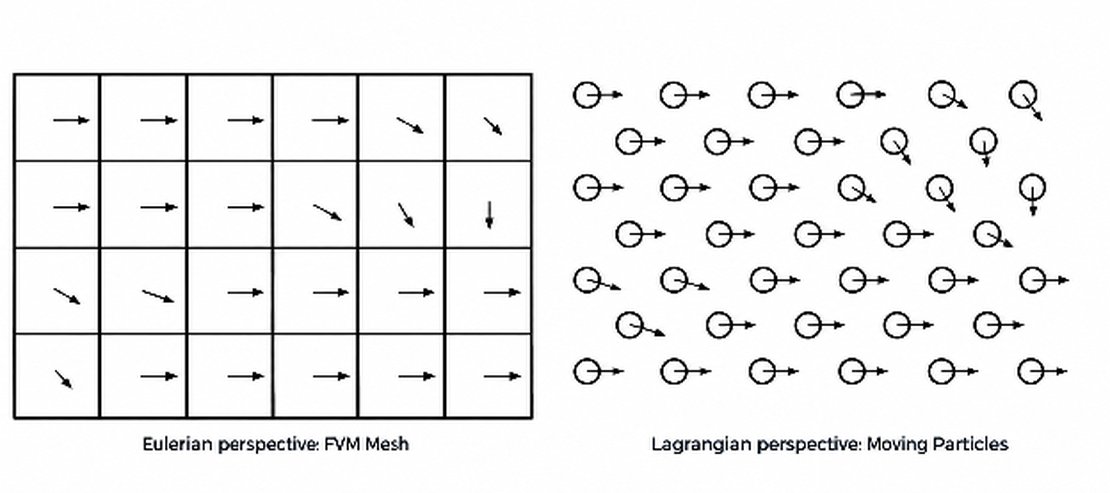
In a conventional CFD solver, the fluid domain is divided into a grid of cells. The solver computes how mass, momentum, and energy move between adjacent cells at each time step. The grid defines the domain, and the grid has to exist before the simulation can start. That means geometry preparation, mesh generation, and quality checks are all prerequisites to running a single calculation.
A meshless method removes the grid entirely. Instead of fixed cells, the fluid is represented as a collection of discrete particles, each carrying its own position, velocity, pressure, and thermodynamic state. Particles interact with their neighbours through a kernel function that weights contributions based on distance. There is no fixed topology connecting them, no cells to fill, and no mesh to generate or maintain. The fluid is the particles, and the particles move with the flow.
One misunderstanding is worth clearing up at this point, because it is the most common one: a particle is not a droplet. A particle is a computational point that carries a small parcel of fluid mass, and on its own it has no fluid properties at all. Pressure and viscous forces only arise from the interaction with neighbouring particles inside the kernel radius. A particle that has lost all its neighbours feels neither. It is simply a small sphere that follows Newton’s laws on a ballistic path under gravity until it meets a wall or other particles again. Fluid behaviour emerges from the interplay of many particles, never from a single one. A droplet, a jet, or a film is therefore only resolved when enough particles represent it, and an isolated particle in a result shows that some liquid travels there, not that a droplet of exactly that size exists.
Strictly speaking, only the fluid is meshless. The solid geometry is still described by a surface mesh. What disappears is the volume mesh of the fluid. The two most established meshless particle methods in CFD are Smoothed Particle Hydrodynamics (SPH) and the Moving Particle Semi-implicit method (MPS), which shonDy is based on. Both solve the same governing Navier-Stokes equations as finite volume solvers. The difference lies in how the fluid domain is represented and how incompressibility is enforced: classical SPH derives the pressure from an equation of state and treats the fluid as weakly compressible, while MPS solves a pressure equation at each time step to keep the fluid incompressible. The Least Squares MPS method (LS-MPS) takes this one step further. It replaces the weighted-average operators of classical MPS with least-squares fits over the neighbouring particles, which keeps the discretisation consistent even when the particles are irregularly distributed, improves accuracy, and reduces the pressure noise that classical particle methods are known for. An LS-MPS solver is available as a beta since shonDy 2026.0.0.
Why the Absence of a Mesh Matters
The mesh in a conventional CFD solver is both its strength and its constraint. It enforces structure on the domain, which makes conservation properties and flux calculations precise and well-understood. But that structure also means the mesh has to remain valid throughout the simulation. When solid boundaries move, the mesh has to deform, slide, overlap, or be regenerated. When the free surface moves, the interface has to be captured on the grid, and keeping it sharp takes either a fine mesh everywhere the liquid might go or adaptive refinement that rebuilds the mesh locally as the interface travels. Both add complexity and, in severe cases, introduce numerical errors or cause the solver to fail.
A meshless method has no topology to preserve. A group of particles that was part of a continuous fluid film can separate from the rest and form a droplet without any algorithmic intervention. A rotating gear can move through a particle field without requiring sliding mesh zones or overset regions. A new free surface forms wherever the particles end, without needing interface reconstruction. These are not workarounds, but direct consequences of the Lagrangian formulation.
Problems the Meshless Method Fits
Three categories of fluid problems consistently favour the meshless approach over mesh-based CFD, simply because the Lagrangian formulation handles them without the geometric complications that mesh-based solvers have to work around.
Fragmenting free surfaces
When a fluid film breaks up into jets, droplets, or splashes (as in splash lubrication inside a gearbox, oil distribution in an electric motor, or fuel sloshing in a tank), the liquid-air interface undergoes continuous topological change. Volume-of-fluid methods capture this interface on the grid, which works well for smooth, slowly evolving interfaces and becomes increasingly approximate as fragmentation becomes more severe, because structures smaller than a cell are smeared out, and adaptive refinement loses its advantage once the interface is spread across the whole domain. In a particle solver, the free surface is simply where the particles end. No interface tracking is required. The resolution limit does not disappear, though. A droplet or a film thinner than a few particle diameters is not resolved either, it is only carried along.
Moving and rotating geometry
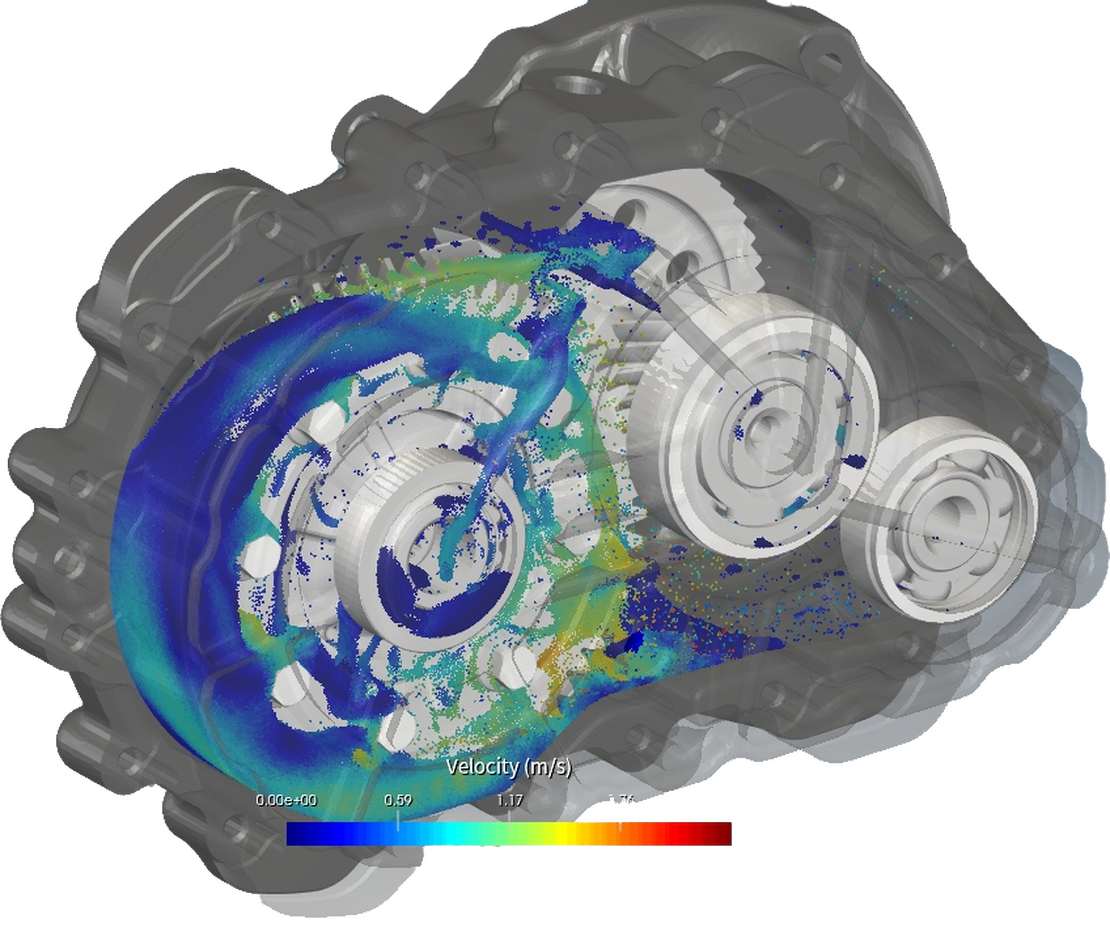
When multiple solid bodies move relative to each other (gears meshing, a rotor spinning inside a housing, multiple shafts at different speeds), a mesh-based solver has to keep its grid valid around every one of them. A sliding interface is enough for a single rotor. Intermeshing gears overlap, so they need overset meshes, continuous remeshing, or immersed boundaries, and usually special treatment of the tooth contact gap. In a particle solver, the solid boundaries are defined as moving wall conditions, and the particles interact with them at each time step regardless of how many bodies are moving. Higher speeds shorten the time step, but they do not change the setup. Our gearbox lubrication case study, for example, runs two gear pairs with distinct gear ratios in the same simulation, without dividing the domain into separate rotating zones.
Highly transient free-surface flows
Problems where the fluid motion itself is the quantity of interest (tank sloshing under external acceleration, water ingestion during a vehicle wading manoeuvre, oil distribution in an electric drive unit) are naturally Lagrangian problems. The particles track where the fluid goes without requiring the solver to reconstruct that path from fixed-cell data.
Problems Where It Does Not
The meshless method is not a general replacement for finite volume CFD. There are problem classes where it is not the right choice, and being clear about this is as important as understanding where it fits. Mesh-based CFD remains the stronger choice for:
- Steady-state flows in a fixed domain, where a finite volume solver can solve for the steady solution directly, while a particle method always has to march there in time
- High-Reynolds turbulent flows, where decades of validated turbulence models have been developed specifically for mesh-based solvers
- Aerodynamic problems, where accurate boundary layer resolution and pressure distribution over a fixed surface are the primary outputs
- Conjugate heat transfer between fluid and solid, where the interface is stable and the thermal coupling is the quantity of interest
- Fully filled internal flows where pressure drop is the primary output, and where finite volume solvers deliver smoother and more accurate pressure fields
- Slow processes that unfold over minutes or longer, such as the warm-up of a component. An implicit mesh-based solver can take large time steps when the flow changes slowly, while a particle method stays bound to small time steps by its particle size
- Flows where the gas phase matters. Free-surface particle simulations usually model the liquid only, so air drag on fine spray, windage at high circumferential speeds, and aeration of the liquid are not part of the result
- Extreme scale separation, such as very thin films or fine sprays in a large domain, where the smallest feature dictates the particle size
- High-speed compressible gas flows, combustion, and cavitation
The choice between methods is a physics question, not a software preference. A problem that fits neither method cleanly may require a coupled approach, such as using a particle solver to characterise the free-surface flow and extract boundary conditions that feed into a 3D/1D hybrid thermal model. The EDU thermal simulation workflow described in our article From Oil Distribution to Peak Temperature is an example of this: shonDy resolves the oil distribution, and shonTA handles the thermal evolution over the drive cycle.
When Meshless CFD Is the Right Choice: A Decision Checklist
The following questions give a practical starting point for assessing whether a meshless method fits a given problem.
| Question | Points to meshless CFD | Points to mesh-based CFD |
|---|---|---|
| What does the free surface do? | It fragments, splashes, or changes topology | There is none, or it stays smooth and intact |
| Do solid bodies move? | Several bodies move or rotate and interact with the fluid | The domain is fixed, or a single rotating zone is enough |
| What is the primary result? | Where the liquid goes over time | A steady state, pressure drop, boundary layers, or turbulence quantities |
| How much physical time is needed? | Seconds, until the flow pattern is established | Minutes or more of a slowly changing flow |
| Does the gas phase matter? | No, the liquid dominates | Yes: compressible flow, combustion, cavitation, windage, or aeration |
| Where does the preparation time go? | Into extracting and meshing a complex fluid volume. A particle solver works directly on the closed surface mesh (see geometry clean-up) | A mesh of the fixed domain is quick to build or already exists |
These are starting criteria, not absolute rules. Many industrial problems contain elements of both, and the right answer is sometimes a coupled workflow rather than a single method.
Conclusion
The meshless method has matured from an academic technique into a practical engineering tool for a specific and well-defined class of problems. It is not a replacement for finite volume CFD, and it does not need to be. It handles fragmenting free surfaces, moving geometry, and transient fluid distribution problems directly, where mesh-based solvers need workarounds. For problems that fit that profile, the absence of a volume mesh is not a limitation, it is the point.
If you want to find out whether meshless CFD fits your own problem, request a trial of shonDy.